Pages

Tuesday, September 5, 2017

The Growth of Ed.D. Programs in Higher Education and Possible Consequences


In January, I took over as coordinator of the higher education specialization within my department’s Ed.D. program. I was hesitant to take on this role because I am still working towards tenure and knew it would entail a major time commitment. However, I taught several required courses in the program and had developed close relationships with the students. I was eager to continue developing a program that both challenged and supported them. At the same time, I was aware that the program faced a number of major issues. One of these issues was the apparent increase in the number of Ed.D. programs in the state and across the region. We certainly weren’t the only player in the game, and it seemed like online and “executive style” programs, in particular, were on the rise. I started to think about the growth in Ed.D. programs and the possible implications. In this post, I’m going to explore why we might be witnesses growth in Ed.D. programs and enrollments, as well as a few consequences for this growth.


Before I jump into the deep end, I want to express a few caveats. First, although Ed.D. programs are designed for educators and professionals of all levels of education, I’ll primarily stick to what I know, which is the field of higher education and student affairs. Second, I’m not at all suggesting that we shut down Ed.D. programs or steer students away from these programs. I’m simply asking what I think are important questions and speculating on answers. Third, I’m not making a statement about the quality of Ed.D. programs relative to Ph.D. programs, and I’m not advocating for one over the other. As I note below, I care deeply about my doctoral students and believe we run an excellent Ed.D. program. I know amazing scholars and practitioners who have graduated from both types of programs. Fourth, I don’t think I have all of the answers. I don’t even know if I’m asking the right questions. So, I invite anyone to engage with me to improve my thinking. Because I care about my students and my program, I’ve thought about these questions and hope you’ll think about them, too.


Are Ed.D. Programs Growing?


An important question to consider right out of the gate is how I know Ed.D. programs are growing. In truth, I don’t know this for certain. It’s an educated hunch. I have carefully monitored programs in North Carolina, as my program has regional orientation and pulls 99% of its students from the state. We’ve caught wind of several new programs, and we’ve also heard of existing programs growing and expanding. At least one program in our state offers classes in several extension sites. (Sidebar: My program also ran extension sites for several years, but we discontinued them.) Additionally, I have openly discussed Ed.D. programs and their growth on Twitter. Several individuals have confirmed my hypotheses, relating that the Ed.D. program in which they teach has grown or been encouraged to grow. So, sure, not exactly the type of data on which I would rely to make big decisions. When time permits, I hope to explore a few datasets that might shed more light on this question and collect some of my own data about program structures and sizes. I invite any readers to educate me one way or another if they have more insight into this question. However, in the meantime, my sense is that there is something here, enough to continue asking questions.


Why Are Ed.D. Programs Growing?


Part of the reason why I think there has been a proliferation of Ed.D. programs is that several structural conditions have emerged to make these programs attractive to individuals and institutions. At the individual level, in the field of higher education and student affairs, obtaining a master’s degree is now required for many entry-level positions and the majority of mid-level positions. Thus, many individuals seeking jobs have the same baseline credential, and competition likely encourages pursuit of additional education to stand out in a busy crowd. Competition has become fierce, in my opinion, because many universities rely heavily upon a large number of entry-level employees, and there are relatively few opportunities for mid-level positions or above. Using common job titles, many universities have a plethora of “coordinator” positions and fewer “assistant director” positions. This is partly the case because coordinators are paid less and, therefore, cost institutions less. Yet this benefit for institutions is problematic for individuals. Those coordinators may struggle to make ends meet, especially if they live in a city or have student loan debt. In this context, individuals have reason to see pursuing an Ed.D. as a pathway to a promotion and better pay.


A common refrain I hear from students in our master’s program is: “I eventually want to be a dean/vice president/director, so I might as well go for my doctorate now.” So, readers might ask why they don’t pursue one of the very good Ph.D. programs in higher education and/or student affairs already in existence. Of course, many do pursue these programs and find success. However, the reality is that many Ph.D. programs are highly selective, and there are more higher education administrators aspiring for upward mobility than spaces at Ph.D. programs. Moreover, some Ph.D. programs assume students will pursue their studies full-time and work part-time. This simply isn’t an option for some prospective students who have bills to pay and/or families to support. Many Ph.D. programs still require that students have a physical presence on campus. This underscores the issue of time. Some Ph.D. programs take 5-7 years to complete, and some students can’t imagine an academic commitment of that magnitude. This concern is exacerbated by fear that Ph.D. programs are more difficult and more theoretical. By contrast, Ed.D. programs can be completed part-time; they can employ hybrid and/or online delivery models; they can be completed in under 5 years; and they can be highly applied, sometimes foregoing the traditional dissertation for other capstone experiences.(Sidebar: I don’t fully buy into some of these distinctions between Ph.D. and Ed.D. programs, but I mention them here for the sake of argument.) In short, the Ed.D. can provide a very attractive option to some students.


It’s no secret that many colleges of education have experienced enrollment shocks. At the undergraduate level, as a consequence of politicians and popular media bashing the teaching profession for years, many colleges of education are struggling to recruit students to education majors. Some states have also cut pay raises for teachers who receive a master’s degree, which has reduced enrollments in certain master’s degree programs. Ed.D. programs have provided a source of new enrollment at a time when other education programs are contracting. And these aren’t just any other students; they are doctoral students. This means that, according to some state funding models, they are worth more in state appropriations than undergraduate students. Furthermore, doctoral students can help institutions that are striving to be perceived or reclassified as more research-oriented. For these reasons, I contend that many institutions have created new Ed.D. programs and/or looked for ways to grow Ed.D. programs through extension sites, new specializations, and/or or going online.


Why Might This Growth Matter?


It’s possible, of course, that the growth in Ed.D. programs and the number of education professionals with Ed.D. degrees aren’t problems. I happen to love coordinating my program, and I think we provide a high-quality education to amazing students. We aim to cultivate scholar-practitioners, and it’s reasonable to argue that more scholar-practitioners is good for higher education. Nevertheless, there are a few possible consequences of the multiplication of Ed.D. programs. If nothing else, I think the field should more proactively initiate a conversation about the topic.


One possible consequence of the growth in Ed.D. programs is that there is an increase in professionals with terminal degrees. Some of these individuals may have relatively few years of experience in the field, yet they possess a doctorate. There are two potential problems with this scenario. The first is that obtaining a doctorate becomes the standard minimum credential to access mid-level positions in higher. In essence, entry-level positions would require a master’s degree, and positions higher up the ladder would require a doctorate. Employers may increasingly expect this qualification among managers and directors because a) there plenty of candidates in the job market with the credential and b) they themselves may have a terminal degree. Employers may expect a doctorate even if the job responsibilities don’t necessarily require the types of skills developed in a doctoral program. Thus, if growth in Ed.D. programs happens too fast or reaches a critical mass, we might see a collective shift upwards in terms of the educational credentials that would not have been required a decade ago.


Relatedly, some individuals may find that their job market expectations are not met because they are “over-educated and under-qualified.” As an educator, I struggle with the idea that anyone can ever be “over-educated.” However, the realist in me recognizes that, irrespective of the terminology, an imbalance of experience compared to degrees could be a problem for some Ed.D. program graduates. To be fair, this is a possible problem for anyone who enters a doctorate with only a few years of professional experience. Heck, I experienced this on the job market not very long ago! (Sidebar: Have I expressedly lately how glad I am to have this job?) As a result, it is hard for me to argue that there is a “right” time in one’s career to pursue a terminal degree. Nevertheless, it’s possible to imagine someone earning their Ed.D., but becoming deeply disappointed if it’s the case that this credential alone isn’t enough to help them take the next step in their career. There could be a multitude of dissatisfied professionals out there who, despite working very hard on their education, have to gather more experience before they get the promotion they desire.


Another consequence of the growth in Ed.D. programs is that it changes the structure and orientation of institutions, as well as colleges of education. I would bet that a significant share of new Ed.D. programs are established at institutions whose main mission is undergraduate education. This means that the institution doesn’t really have infrastructure for graduate education or, more specifically, doctoral education. For example, the institution might not have tutors in the writing center who can help graduate students, or the center may not be able to provide services online or after working hours. The institution might not have funding support for conference travel. It’s library may not have adequate resources or research support. Operating a doctoral program, one that serves full-time professionals, requires that some institutions and colleges of education rethink and alter their practices to better support these students. Additionally, colleges of education may have to seriously consider their mission if an increasing percentage of their students are at the graduate level. They may no longer be primarily colleges of teacher preparation, but rather colleges of leadership development. Lastly, colleges of education may have to think about the type of faculty member that needs to be recruited, hired, and developed to teach/advise doctoral students. Starting an Ed.D. program can be relatively straightforward, but making an Ed.D. program successful requires careful planning and management on the part of institutions and colleges of education.


My worry is that institutions are attracted enough by the enrollment boost to sidestep these crucial conversations. There is an ethical question at play here if it is the case that institutions are enrolling students and accepting their tuition without being fully prepared to support them, or fully aware of the program outcomes.


Conclusion

This is a call to start a larger conversation about doctoral education in higher education and student affairs. In particular, I think we should have an honest discussion about the growth of Ed.D. programs and the experiences of Ed.D. program graduates. What does the proliferation of these programs mean for the education job market, the perceived value of terminal degrees, and the structure of institutions/colleges hosting these programs? I argue that we should more closely study Ed.D. programs, including the enrollment figures and the outcomes. I’m attempting to do that in my program; attempting to ensure that we’re giving students the best possible experience to translate their education as scholar-practitioners into positive returns. But my concerns linger. With a little luck, I’ll be able to tackle some of these questions through empirical research in the near future.

Tuesday, July 18, 2017

Is There a College Amenities Arms Race? Moving from Rhetoric to Research

I recently had a conversation with a writer who was working on a piece related to the college amenities arms race. It was a good conversation, and I was grateful to be consulted because I’ve spent significant time thinking about transformations in the built environment of college campuses. I shared with the writer my issue with most writing on the college amenities arms race. All of the articles I have read assume that a college amenities arms race ever existed in the first place. Here’s the problem with this assumption. It’s exactly that--an assumption. We have little empirical evidence that there is a college amenities arms race and even less proof that it contributes significantly to rising costs or tuition prices. The absence of data-driven analysis and proper contextualization of amenities in higher education leads to blatant mischaracterization of the financial realities at most colleges and promotes misunderstanding of student services.


There is cottage industry built around writing on amenities in higher education, one that fixates on portraying colleges as flush with cash, overrun with greedy administrators, stuffed with unnecessary luxuries. I found at least a dozen popular media articles about the college amenities arms race. (Note: I have created a running list of these articles here.) When these articles speak of a college amenities arms race, they refer to the practice of strategically constructing increasingly expensive and luxurious buildings as part of an endless competition to recruit and retain students. For many observers, the proliferation of amenities is a pernicious plague responsible for a range of ills in higher education, from excessive administrative spending to soaring student loan debt. The worst of these articles could be fairly characterized as “click bait,” or an effort to lure uninformed readers with salacious headlines and images of students enjoying water slides and lobster dinners.  


Part of the difficulty in establishing the existence of a college amenities arms race is that there is no agreement around what constitutes an amenity in higher education. We typically think of amenities in the context of hotels or apartments. In this context, amenities are unique features and comforts, many of which are above and beyond those items consumers view as necessary. For example, a hotel would likely include on its list of amenities a full-service spa or fresh baked cookies, but probably would not list beds and lamps. Articles on the college amenities arms race commonly identify as amenities those features of campus that are unrelated to the academic enterprise, things like lazy rivers, climbing walls, and niche dining options. However, other articles point to new libraries and study spaces as amenities, which are decidedly academic in purpose. Moreover, there is a tendency to conflate any construction project that is new or expensive as an amenity. Using the hotel example above, this would be like calling a new Holiday Inn an amenity.


Even if there is agreement that a lazy river is an amenity in higher education, how much construction involving which amenities is enough to comprise an arms race? A college might receive a major goft to upgrade its recreation center, which is badly in need of repair. The new recreation center might include a lazy river. However, once the project is finished, the college may not upgrade the recreation center for another decade (or more), and it may not break ground on a project of such magnitude for several years. Part of the rationale in constructing the recreation center is that there was a donor willing to help pay the tab, and there’s no guarantee this donor will stick around forever. Is it accurate to say the college is actively engaged in an amenities arms race? In other words, the mere existence of what we might agree is an amenity on campus (i.e., the lazy river) does not necessarily provide evidence of participation in an arms race. This evidence requires a more detailed conceptualization of the role of amenities and the built environment in higher education’s competition.


Because there is no definition of amenities in higher education, it is difficult to measure the phenomenon. Sightlines, a facilities management firm, maintains the most comprehensive database on campus construction projects. Yet this database only includes 350 out of over 7,000 postsecondary institutions. Lacking accurate measures, we don’t know how widespread the college amenities arms race might be. Articles suggest that the amenities arms race is ubiquitous in higher education, yet they use as evidence the same small set of colleges (e.g., High Point University). To be sure, some of these institutions might be guilty of amenities arms racing. However, readers are made to believe that what’s true at these colleges is true of all colleges. We are comfortable accepting this improper generalization because we can point to an amenity or two we’ve seen at our alma mater or local campus. However, I argue that we should avoid this type of generalization and seek out data that allows us to more accurately capture the nature and scope of amenities arms racing.


A recurring claim in writing about the amenities arms race is that all these flat screen TVs and tanning beds are driving up college costs, which are subsequently passed onto students in the form of tuition. Many of the articles mention the college amenities arms race in the same breath as mounting student loan debt. In fact, we know surprisingly little about the effects of amenities-based competition in higher education. The Delta Cost Project explored the relationship between spending on facilities and tuition in a report appropriately titled “Climbing Walls and Climbing Tuitions”. The authors argued that only a small share of spending on facilities went to amenities. Their main conclusion was that “climbing walls are easy targets, maybe even fair game, but they aren’t what’s behind the rising price of college” (p. 4). But amenities can influence students’ college choice process. In a forthcoming article in the Journal of Labor Economics, Brian Jacob and colleagues found that academically middle-of-the-road and wealthy students were significantly more willing to pay for consumption amenities. Colleges that admit more of these students have incentive to respond to this preference by spending more on consumption amenities. It is worth noting, however, that neither study supports the existence of an amenities arms race or shows that it contributes to tuition or student loan debt.


The truth about amenities is likely far less interesting than the popular media thinks. The financial realities at many colleges do not cohere with images of resorts and country clubs that are so common in articles on the amenities arms race. More municipal golf course than country club, many colleges are struggling to stem regular cuts in state funding, avoid staff layoffs and furloughs, maintain or even increase enrollments, and pay for upkeep of existing facilities. New construction projects at these campuses, some of which may include amenities like those described above, may be more a function of necessity or opportunity than competitive strategy. For example, some colleges have constructed new dining halls because companies like Aramark are willing to foot the bill in exchange for exclusive food service contracts. Additionally, my research on student housing shows that many campuses constructed residence halls through public-private partnerships, which are similarly financed by a private company, in order to meet student demand and upgrade badly deteriorating facilities. These partnerships have been made all the more attractive in states where the legislature has prohibited using state funds to construct non-academic buildings. In other words, the money for these fancy, new buildings didn’t come from taxpayers or student tuition.


What many writers looking at the college amenities arms race fail to consider are the political-economic conditions that explain the increasingly fierce competition in which colleges are enmeshed. Sheila Slaughter and Gary Rhoades demonstrated in their work on academic capitalism that as state support for higher education has waned, colleges have become embroiled in competition for other revenue sources, namely students who can pay tuition with minimal assistance, research grants and contracts, and private donations. Administrators have prioritized units that foster these revenue sources, which could result in greater supply of amenities. Blame for the existence of amenities is rarely directed at the external pressures to which colleges are responding. Rather, responsibility often falls on the shoulders of the nameless, faceless, greedy administrator who is siphoning money from instruction to pay for luxury residence halls. Although amenities on campus are certainly the result of decision-makers on campus, many of whom are administrators, there is no monocle-wielding monopoly man maniacally laughing as he transforms your campus into mini-Disney. Amenities are a reflection of the present moment and the competition into which colleges have been thrust to remain solvent.


One of the big losers in the conversation on amenities in higher education is student services, or student affairs. Student affairs is the part of college administration dedicated to student well-being and development out of the classroom. But this is a very narrow and simplistic view of student affairs, which is a key partner in students’ learning, development, retention, and graduation. Student affairs is often swept into critiques of the amenities arms race because student affairs professionals often work in or manage residence halls, recreation centers, student centers, and similar facilities. This promotes a significant misunderstanding of student services because it casts the work of student affairs professionals as little more than facilitating students’ leisure and pleasure. It strips student affairs professionals of their important role in student learning and development and instead paints them as glorified camp counselors and tour guides. Here’s an example to illustrate my point. More than one article on the amenities arms race includes high-ropes courses in their description of amenities. As a graduate student and higher education professional, I interacted frequently with my college's outdoor education center. The high-ropes course employed dozens of students, who participated in leadership development courses and experienced truly transformational growth. Countless of the college’s programs used the high-ropes course to help with community building efforts. Because summer camps utilized the high-ropes all through the summer, I would be surprised if this “amenity” didn’t generate net revenue. Is the high-ropes course an amenity? Maybe. But it was remarkably successful at developing students as leaders. That is the bread and butter of student services, which gets lost when we don’t apply nuance to our thinking and writing on amenities.


My point is not to necessarily defend amenities or suggest we ignore the role of amenities in higher education’s intensifying competition for students and money. As someone who pays close attention to amenities and other changes to the build environment of college, I’m honestly troubled by what I see on many campuses. Although I often find the narrative around college amenities in the popular media persuasive, I have forced myself to reject easy answers and ask deeper questions. Among these questions are how amenities influence the experience of low-income students and their ability to afford college. Some of my research has tackled this question, but it provides only a snapshot. Rather than read yet another article about lazy rivers and climbing walls, I’m calling on my higher education colleagues to help me conceptualize the role and effects of amenities in higher education finance and management. We need research, not rhetoric, to know for sure if there is a college amenities arms race and how it intersects with the major questions of access, affordability, and completion in higher education.


Friday, July 15, 2016

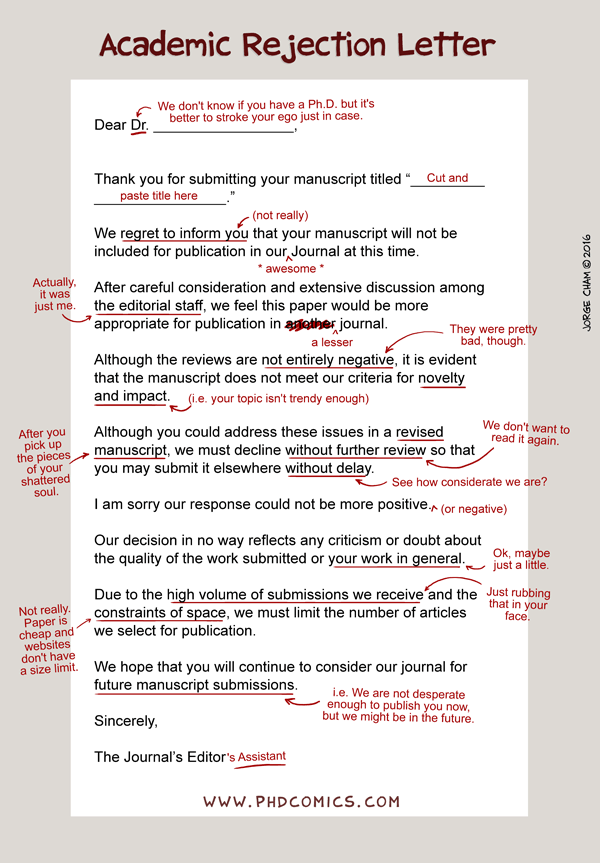
Attention Higher Education Faculty and Professionals: We Need to Take Peer Review More Seriously

A significant part of my job as a professor is to write research-based manuscripts, grant applications, and conference proposals. My success in publishing journal articles, presenting papers, and securing extramural funding will help to determine that my academic freedom and due process rights are protected through the granting of tenure. What this means is that I spend a good deal of time contending with peer review. Simply put, my career prospects are frequently predicated on peers’ assessments of my work. This makes peer review deeply important and personal to me.

Unfortunately, my experience with peer review has been decidedly mixed and getting worse. No, it hasn’t been negative because I'm bitter that reviewers don’t like my work. My mentor taught me early on that the best scholars take critique gracefully, so when reviewers sincerely raise questions about my work, I tend to give the comments significant thought. No, my experience with peer review has not been negative because reviewers have been rude or even nasty (though I have had a few borderline instances of this). My problem with peer review is that people don’t seem to take it seriously enough. Moreover, there are too few organizational checks in many review processes to prevent shoddy reviews from being sent out.

I can only speak to my own experience, which is based in the field of higher education. In the past year, I have received: 
  •        One review for a journal manuscript that was a single sentence. This was after a 6-month wait for a first-round review.
  •       One review for a conference proposal in which the reviewer indicated “not applicable” for most of the categories and offered as written feedback: “This is his total research”.
  •      One review for a journal manuscript where the reviewer inexplicably conflated the theoretical framework and methods. (We used a theory that was derived from a long-term study that collected data at over 100 liberal arts and comprehensive universities. The reviewer thought we should expand the number of institutions in our study to include community colleges!)
  •     One review for a conference proposal in which the reviewer felt they could not evaluate the conclusions and deemed the paper would not be complete because data had only been collected at 2/3 institutional sites. (We offered preliminary findings based on the 25 interviews that had already been conducted at the two sites.) 


It would be easy to simply shrug these experiences off as byproducts of an imperfect but generally functional system. You might also simply label me a poor loser, and I’ll own up to that. However, I think there are larger issues at play—issues at the individual and organizational level.

At the individual level, I suspect that there are a range of conditions and characteristics leading to reviews of poor quality.

#1 The just-in-time reviewer – This is the reviewer that leaves just enough time before the deadline to quickly scan your paper and offer a few generic but largely unhelpful comments. I also put in this category the “always too busy” reviewer, who probably should not have agreed to take on this responsibility but did and then found themselves simply too busy to give it due consideration.

#2 The unprepared reviewer – This is the reviewer who has been asked to review a paper they don’t understand for one reason or another. Perhaps it uses a research method with which they are not particularly well versed. Perhaps it is a graduate student or new professional who simply hasn’t learned how to conduct a review properly.

#3 The ne’er satisfied reviewer – This is the reviewer who will never, under any circumstances, concede that someone else’s work has value. Alternatively, this reviewer has been burned by enough reviewers that they use peer review to settle scores.

#4 The neglectful editor – I’ve never been an editor, so I’m speculating here. However, many of the terrible reviews I’ve received have ostensibly been seen and okayed by an editor. If you are an editor, and you see that a reviewer patently misunderstood the study or provided nothing but a few words of feedback, you are part of the problem.

At the organizational level, I see a host of problems that facilitate shoddy peer review. Again, my comments here are specific to the field of higher education.

#1 Too few scholarly associations and journals – In the United States there is basically one, maybe two, scholarly associations dedicated to the study of higher education broadly. Yes, there are a host of professional organizations for a variety of administrative functional areas. However, these organizations don’t always care much for scholarly research, and if you are interested in things outside of student affairs, you have relatively few conferences from which to choose. Similarly, there are just a few generalist peer-reviewed journals. The result is intense competition to have papers accepted in these venues. I have heard (and am even guilty) of submitting absurd numbers of proposals to conferences in the hopes something will land. Specific to peer review, this means that reviewers are being bombarded with a huge number of papers for a small number of slots. It’s a recipe for low-quality peer review.

#2 Small boxes, narrow perspectives – Many of the higher education conferences force you to place your work within a category: students, faculty, policy, and so forth. There are many, many research topics, however, that simply do not fit neatly in one or any of the boxes. As a result, reviewers are sometimes perplexed about whether to accept the paper or reject it for lack of “fitness”. In the same vein, the rubrics that are used to evaluate papers for conferences tend to adhere to very traditional structures of scholarly presentation: purpose statement, literature review, theoretical framework, methods, findings, significance. If you happen to be working on something just a little outside of the norm, you inevitably receive lower scores. Lastly, the field of higher education is besieged by an infatuation with large datasets, both quantitative and qualitative. I can’t tell you how many times I’ve seen: “This is a great study, but data is from just one institution, so we can’t do anything with it.” Recycling tropes of such narrow epistemological orientations lead to a devaluing of many types of research through the peer review process.

#3 Lack of education – We frequently fail to teach graduate students how to conduct professional peer review. This means they learn how to conduct peer review through their own experiences with peer review, thus perpetuating a cycle.

There are likely a few other reasons at both the individual and organizational level that have led, in my opinion, to the degradation of peer review. Thankfully, I think there are some concrete steps we, as a field, can take to address the problem.

First, I think editors need to play a more active role in vetting reviewers and reviews. The best journal I’ve had the pleasure of working with seemingly utilized a team of talented editors who had clearly both read my paper and the reviewers’ comments. The result was excellent feedback and stronger manuscript. Although it sounds extreme, if you are part of an editorial team sending out shoddy reviews, I think you should think long and hard about the integrity of your enterprise.

Second, we need some visionary young faculty and professionals to dream up new venues for presentation and publication. We desperately need more generalist venues for higher education scholarship, but also alternative venues that don’t so strictly adhere to convention.

Third, we need to orient our graduate students to the peer review process: why it matters, how it works, and what a professional review looks like. I think it is wonderful to include graduate students in conference review processes, but we have to ensure that they are prepared to take on the responsibility. 

Lastly, and most importantly, we need to respect peer review. This entails giving peers’ work the time it deserves and providing thoughtful, constructive feedback. It means not taking on too many commitments, diluting the attention you can give to someone’s paper or proposal. If you have ever complained about a peer review, be a part of the solution by ensuring your own reviews are high quality. In other words, you don’t get to complain about a review one day, then conduct a shoddy review the next day.


Professionally, much of my work lives and dies on the basis of peer review. And I’m not alone here. So, I’m calling on higher education faculty and professionals to take peer review seriously.